For most financial institutions, the breaking point arrives quietly: a backlog that grew too large to manage, a regulatory exam that exposed documentation gaps, or an audit finding that pointed directly at the limitations of a homegrown workflow tool.
These moments often stem from legacy infrastructure where core systems and internal tools operate in silos, limiting coordination and data visibility across teams. At that stage, the conversation turns from modernization to execution: develop internally or adopt a purpose-built platform.
Ultimately, the buy vs build decision is less about technology preference and more about operational scalability and control.

When Does Building Make Sense?

Building internal systems is not always the wrong choice. Institutions with highly specialized workflows, deep integration requirements, or strong in-house domain expertise may have valid reasons to build.
But even when building is the right initial decision, the long-term costs cannot be ignored, including time, talent, and ongoing maintenance responsibilities.

Why Buying Is the Strategic Alternative to Internal Development?

1. Speed to Value

At large U.S. banks that disclose technology spending data, “run the bank” and mandatory change initiatives consume up to 70% of technology budgets. That leaves little to no room for building new capability from scratch.
The in-house case management solutions typically take 12 to 24 months to reach production, before accounting for integration delays, change management, and expanding project requirements. While delivery is delayed, case backlogs grow, teams remain dependent on manual processes, and regulatory risk continues to rise.
When a financial institution buys a solution, it goes live in weeks. Teams can begin processing cases on day one, enabling faster resolution times, fewer regulatory issues, and earlier return on investment.

2. Built-In Compliance Expertise from the Start

Purpose-built platforms come with compliance requirements already embedded and aligned with how U.S. financial institutions operate. They are designed based on years of implementation experience across similar institutions, ensuring they reflect real-world practices. As a result, they are better equipped to support day-to-day operational needs.
Replicating this internally requires hiring compliance and engineering specialists or bringing in consultants, who can translate regulatory requirements into technical specifications. Most institutions lack both capabilities in-house, which slows development, increases costs, and makes long-term sustainability more challenging.

3. Shared Accountability with a Trusted Partner

When an institution builds internally, there is no external partner accountable when systems fall short, break, or need to adapt. The responsibility rests entirely with the institution.
With a purpose-built platform, that dynamic changes. The vendor carries contractual obligations, dedicated support structures, and a direct reputational stake in the institution’s success. This also allows internal teams to stay focused on higher-value strategic priorities, such as product development or customer escalations, rather than maintaining systems that were never their core competency.

Data-Backed Analysis: Why Financial Institutions Prefer Buying Over Building?

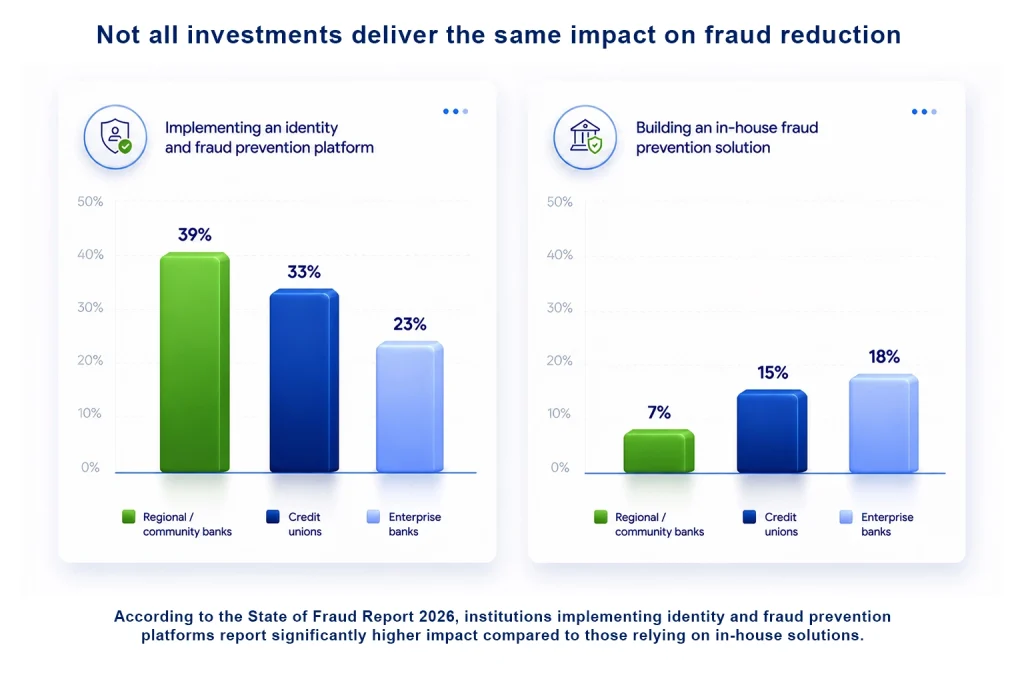
Financial institutions relying on in-house fraud prevention solutions operate at a measurable disadvantage, as the fraud reduction outcomes illustrated in this graph clearly demonstrate. For institutions serious about staying ahead, the data makes a compelling case for reconsidering whether building a solution is worth it.

From Procurement to Partnership: Rethinking Vendor Selection

The decision to adopt a technology solution does not end with the buy vs build choice. Financial institutions must also be mindful of vendor selection. Many institutions experience what can be described as “vendor hide and seek,” where what is promised during evaluation does not always match how the platform performs in practice.
This is why institutions must look beyond feature comparisons and focus on execution. The platform reflects financial use cases, integrates with the existing environment, and allows teams to make changes without constant technical dependency.
Ultimately, what every financial institution needs is a committed partner, not just another vendor added to the procurement process.

Replacing Fragmented In-House Systems with CaseHUB

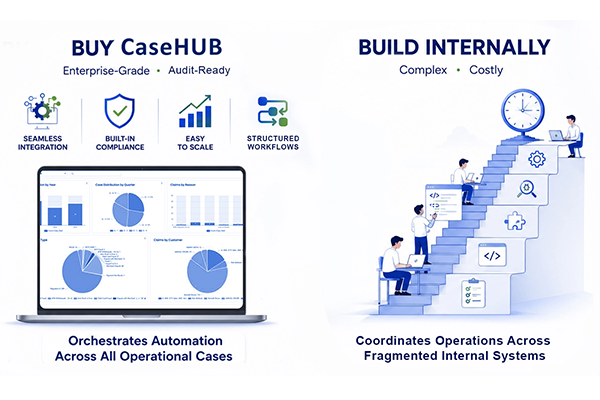
CaseHUB is an enterprise case management platform that orchestrates automation across operational workflows, giving teams a complete view of every case, its status, and its deadline.
By replacing various siloed tools with a single governed platform, it manages operational cases end-to-end with faster processing, less manual effort, and without the engineering overhead of building and maintaining an internal solution.
Buy vs Build for Financial Institutions